Welcome to your holistic living
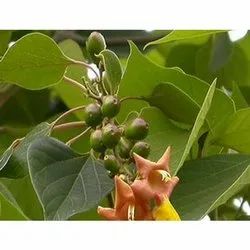
Botanical Name: Gmelina arboreal Linn
Family: Verbinaceae
English Name: White teak
Malayalam Name: Kumbil
Hindi Name: Gambhara
A large deciduous tree,20 m high ,leaves - large , tomentose under Neath ,cordate -ovate ,acuminate.Flowers - yellow ,tinged with brown,in terminal and axillary racemiform panicles,composed of lateral cymes.Fruits -drupes,yellow when ripe.seeds - oblong .Flowering in February - April and fruiting in April - July .Gmelina arborea grows naturally throughout India, Myanmar, Thailand, Laos, Cambodia, Vietnam and in southern provinces of China. It is found at altitudes from sea level to 1,500 metres (5,000 ft).[1] Since the 1960s, it has been introduced extensively as fast-growing timber trees in Brazil, Gambia, Honduras, Ivory Coast, Malaysia, Malawi, Nigeria, the Philippines, and Sierra Leone. It is also planted in gardens and avenues. Utilization Bark Flower The species is fast-growing and thus raised in large-scale plantations to produce wood for construction, crafts, paper pulp, fuel, and charcoal. It produces high-quality wood used in the manufacture of furniture and to make plywood, matches and agricultural implements. The nectar of the flowers yields high-quality honey. The Lion Throne, the most important, and last surviving, of the eight royal thrones of Myanmar, now in the National Museum in Yangon, is carved from Gmelina arborea wood. Chemistry Lignans, such as 6" - bromo - isoarboreol, 4-hydroxysesamin, 4,8-dihydroxysesamin, 1,4-dihydroxysesamin (gummadiol), 2-piperonyl-3-hydroxymethyl-4-(α-hydroxy-3,4-methylenedioxybenzyl)-4-hydroxytetrahydrofuran and the 4-O-glucoside of 4-epigummadiol, can be isolated from the heartwood of Gmelina arborea. The parent compounds are arboreol or gmelanone. Umbelliferone 7-apiosylglucoside can be isolated from the root. Five constituents, isolated from the heartwood of G. arborea, (+)-7′-O-ethyl arboreol, (+)-paulownin, (+)-gmelinol, (+)-epieudesmin and (−)-β-sitosterol, show antifungal activity against Trametes versicolor.
Root bark, fruit, flower, leaves
Diuretic → Increases urine flow, aiding detoxification and kidney health. Respirstory system Expectorant → Promotes expulsion of mucus from the respiratory tract. Anti-asthmatic → Relieves bronchospasm and eases breathing. Digestive System Appetizer & Digestive stimulant → Improves appetite and enhances digestive enzyme activity. Laxative → Promotes bowel movement and relieves constipation. Anti-ulcer → Protects gastric mucosa and reduces acidity. Immune System Immunomodulatory → Enhances immune response by balancing cytokine activity. Musculoskeletal System Anti-inflammatory → Reduces tissue inflammation by suppressing inflammatory mediators. Analgesic → Provides pain relief in musculoskeletal conditions. Anti-arthritic → Helps reduce swelling and stiffness in arthritis. Urinary System Diuretic → Promotes urine flow and aids detoxification. Hepatic System (Liver) Hepatoprotective → Protects liver tissue against oxidative and toxin-induced damage. General / Multi-systemic Antioxidant → Neutralizes free radicals, reducing oxidative stress. Antimicrobial → Inhibits bacterial and fungal growth. Rejuvenative (Rasayana) → Supports overall vitality and strengthens body tissues. Antipyretic → Reduces fever by regulating thermoregulatory centers.
1.stomachic 2.Refrigerant 3.Demulcent 4.Laxative
Rasa: Tikta, Kashaya, Madhura
Guna: Laghu , Ruksha
Virya: Usna
Vipaka: Katu
Dosha Karma: Tridosha shamaka