Welcome to your holistic living
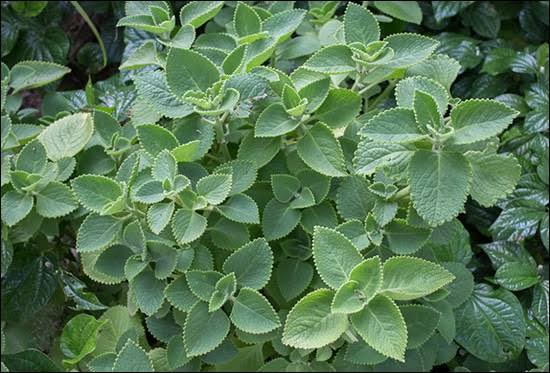
Botanical Name: Plectranthus amboinicus
Family: Lamiaceae
English Name: Indian Borage / Mexican Mint / Country Borage / Indian Oregano
Malayalam Name: Panikoorka
Hindi Name: Patharchur, Ajwain Patta, Patta Ajwain
Plectranthus amboinicus (Lour.) Spreng. of the Lamiaceae family is a perennial herb encountered typically throughout the tropics of Asia, Australia and Africa. The herb is rich in natural phytochemical compounds that have high end nutritional and therapeutic properties. This makes the herb highly appreciated in the pharmaceutical industry. In addition, the herb has profuse essential oil content and aromatic properties that makes it a horticultural treasure. It is extensively used in indigenous systems of medicine to cure health conditions like fever, cough, headache, cold, asthma, skin diseases etc. The leaves of the herb are also used as flavoring agents in the traditional cuisines. Studies disclose that the herb has antimicrobial, antioxidant, anti inflammatory, wound healing, analgesic and anti epileptic properties. It is also known to cure digestive, cardiovascular, respiratory, urinary and skin disorders. Justicia adhatoda is a shrub with 10-20 lance-shaped leaves 8-9 centimeters in length by four wide. They are oppositely arranged, smooth-edged, and borne on short petioles.[citation needed] When dry they are of a dull brownish-green colour. They are bitter-tasting. When a leaf is cleared with chloral hydrate and examined microscopically the oval stomata can be seen. They are surrounded by two crescent-shaped cells at right angles to the ostiole. The epidermis bears simple one- to three-celled warty hairs, and small glandular hairs. Cystoliths occur beneath the epidermis of the underside of the blade. The trunk has many long opposite ascending branches, where the bark is yellowish in color. Flowers are usually white and the inflorescence shows large, dense, axillary spikes. Fruits are pubescent, and are with club-shaped capsules.
Leaves
1. Relieves congestion: It acts as an expectorant, helping to clear excess mucus and phlegm from the respiratory tract. 2. Eases breathing: Its bronchodilator properties can help with conditions like asthma and bronchitis. 3. Fights infections: Its antimicrobial properties may help fight respiratory infections. 4. Soothes the stomach:The anti-inflammatory compounds in the plant can soothe stomach inflammation and alleviate symptoms of Irritable Bowel Syndrome (IBS). 5. Aids digestion:It's used to treat general indigestion, flatulence, and other stomach discomforts. 6. Reduces inflammation: Applied topically, it can reduce swelling, redness, and irritation on the skin. 7. Heals wounds: Its analgesic, anti-inflammatory, and antioxidant properties aid in wound healing. 8. Treats bites and stings: It is used to relieve pain and inflammation from insect bites and stings.
Antitussive, expectorant, carminative, antimicrobial, anti-inflammatory, antioxidant, antispasmodic, antipyretic, galactagogue, wound healing.
Rasa: Katu, Tikta
Guna: Laghu, Snigdha, Tikshna
Virya: Usna
Vipaka: Katu
Dosha Karma: Vatakapha shamaka